Plinia longiacuminata
Family / Familie: Myrtaceaeorigin from / Herkunft: Brasil / Brasilien Climate / Klima: temperate to warm (15-30C / 59-86F) / gemäßigt bis warm (15-30C / 59-86F)Use / Verwendung: edible fruits, juice, jam, ice cream, etc. / essbare Früchte, Säfte, Marmelade, Eis usw.you buy / sie kaufen: 1 germinated seed / 1 gekeimter Samen
Delivery worldwidePlinia longiacuminataA rare, large-fruited Jaboticaba with elegant growth and collector appeal
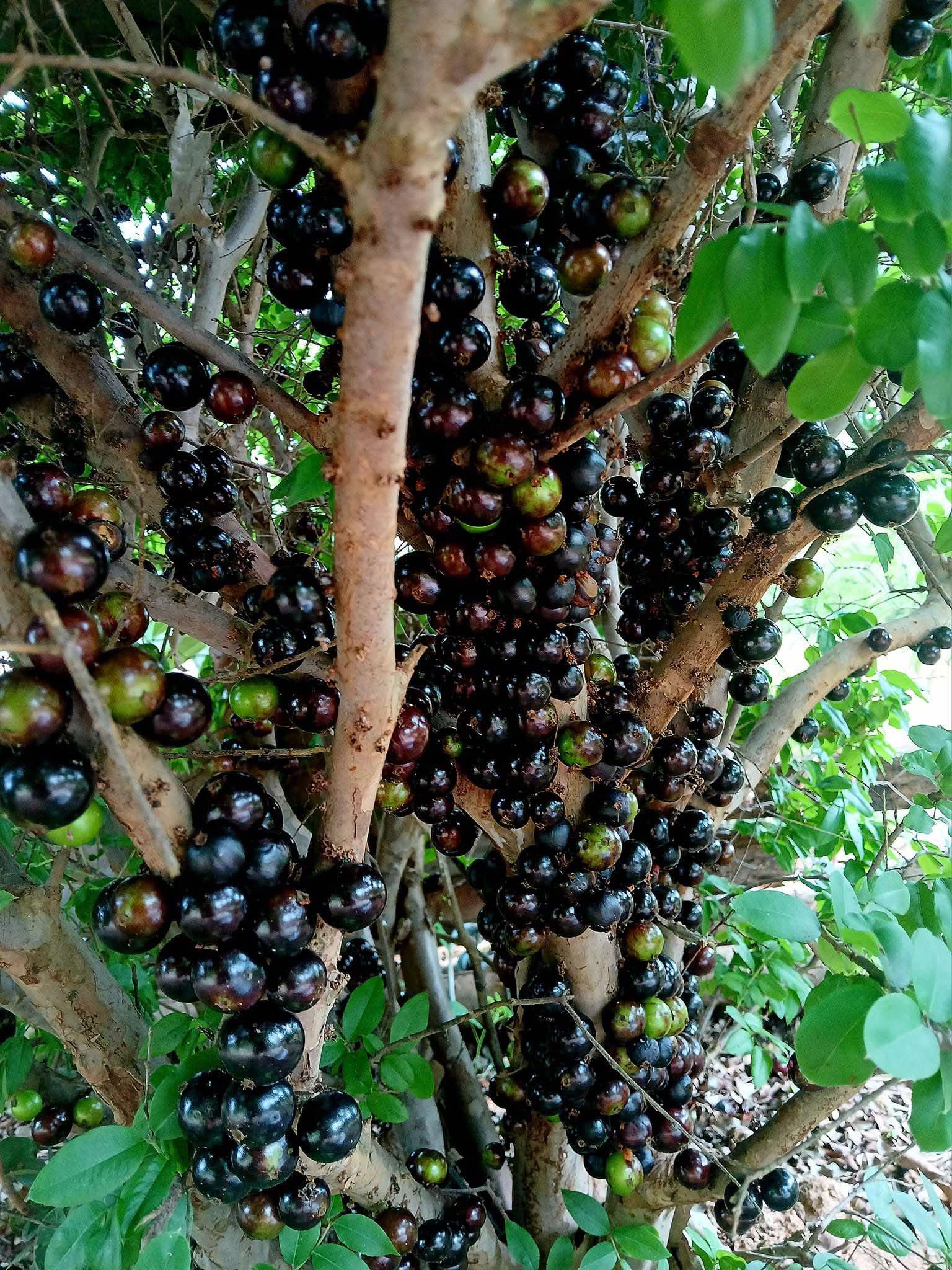
With Plinia longiacuminata, you're holding something truly special – a freshly harvested seed of one of the most sought-after Jaboticaba species, even among Brazil's most dedicated plant collectors. This exceptional tree was discovered in the biodiverse region of Itacaré, Bahia, and is virtually unknown in cultivation.
A collector's gem with striking featuresThis fast-growing tree can reach around 6 meters in height and is notable for its long, narrow, pointed leaves that give it a refined, tropical appearance. Due to its rarity and recent discovery, Plinia longiacuminata is nearly impossible to find in the trade – a true highlight for rare fruit collectors.
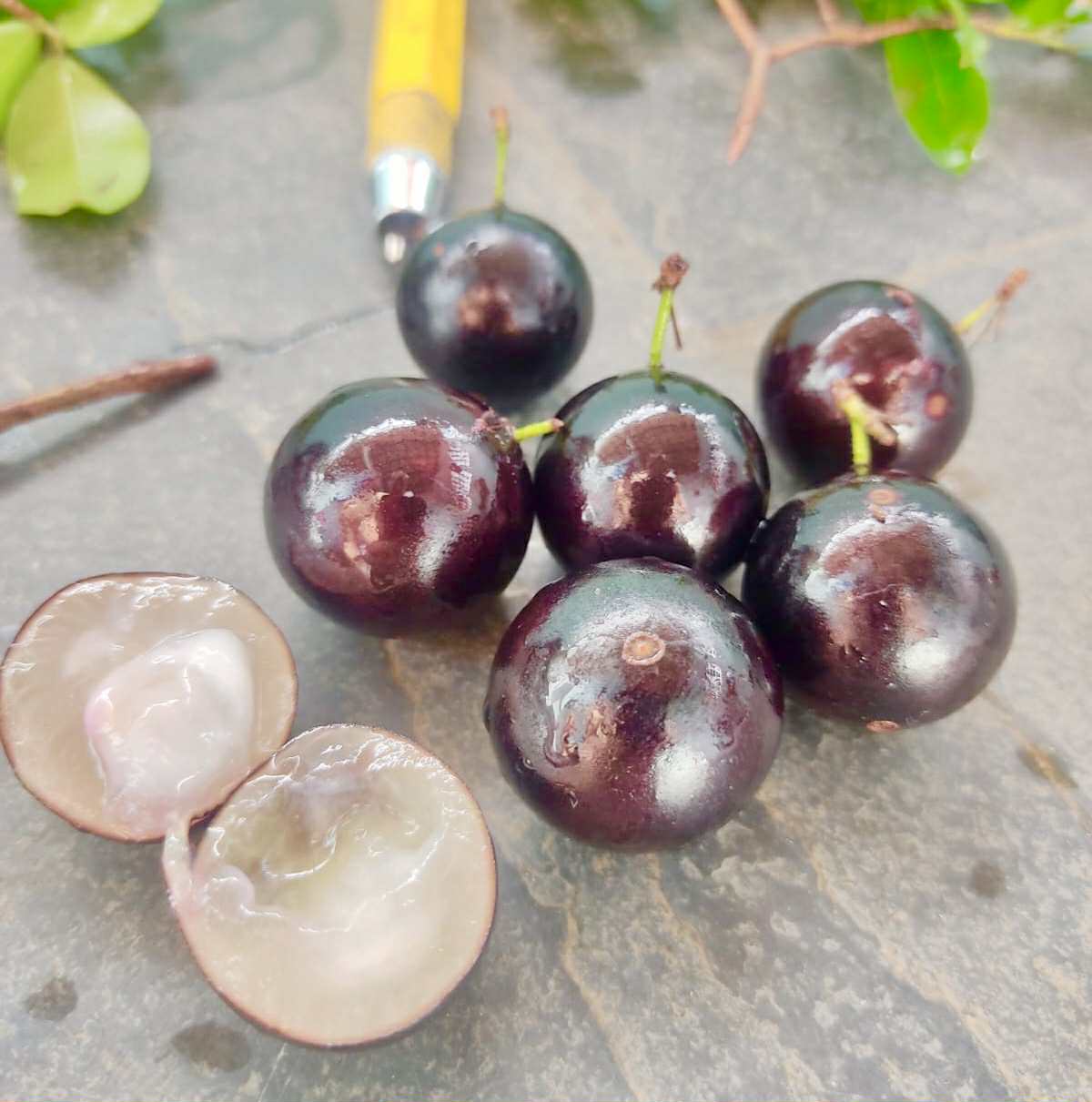
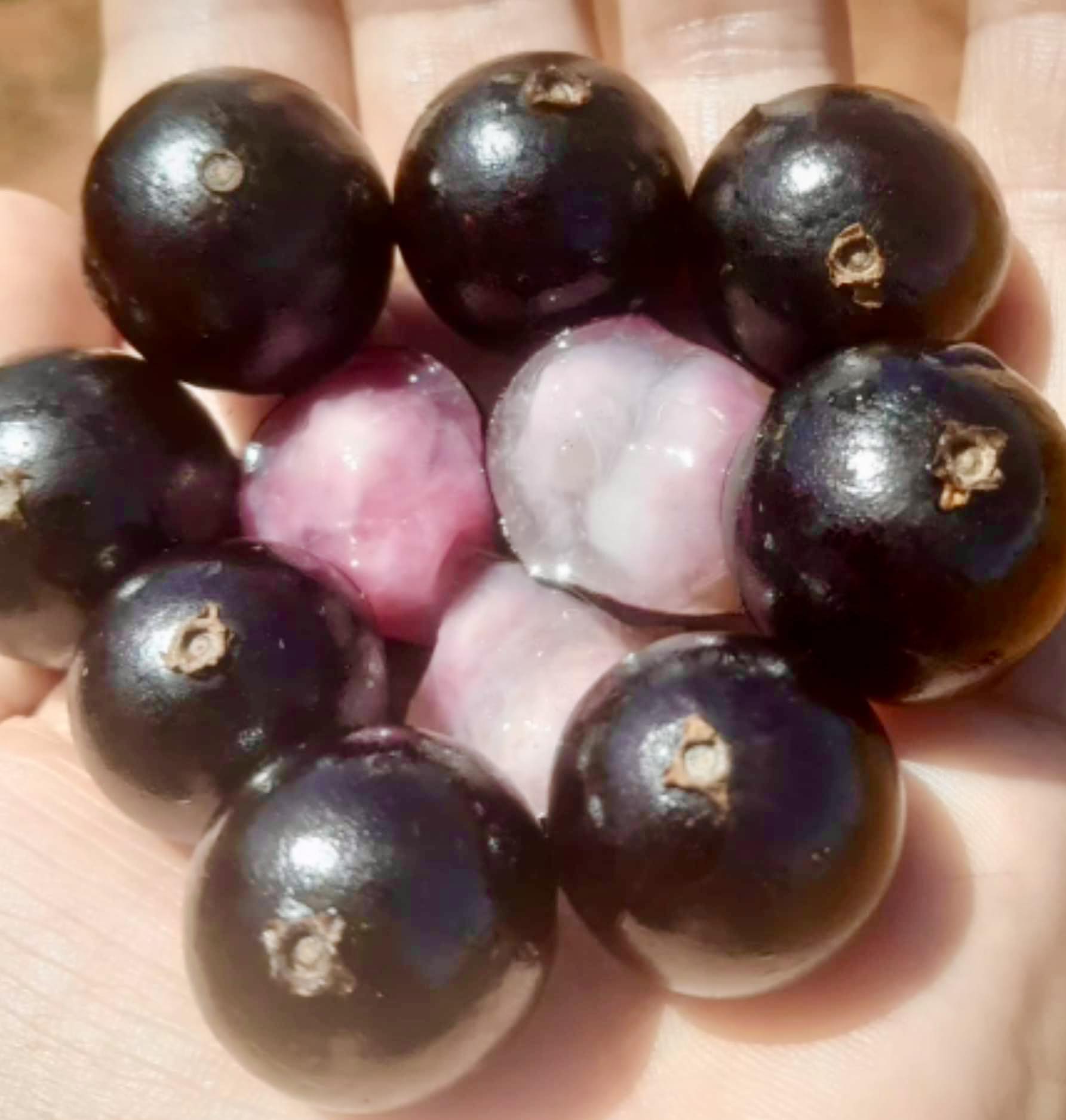
Exceptionally large fruits with excellent flavorThis Jaboticaba produces unusually large fruits, setting it apart from most species in the genus:
The pulp is sweet, aromatic, and perfect for eating fresh out of hand.
The fruits contain a large seed, making them not only delicious but also botanically intriguing.
Care RequirementsBeing a tropical species, Plinia longiacuminata requires warmth and protection from cold. It should be overwintered at a minimum of 15°C (59°F). A bright, humid environment such as a greenhouse or sunroom is ideal during cooler months.
A hidden tropical treasure – with Plinia longiacuminata, you’re adding a refined and rare Jaboticaba to your collection straight from the rainforests of Bahia.
Plinia longiacuminataEine seltene, großfrüchtige Jaboticaba mit beeindruckender Wuchsform
Mit Plinia longiacuminata halten Sie eine ganz besondere Rarität in den Händen – einen frisch geernteten Samen einer spektakulären Jaboticaba-Art,die selbst bei erfahrenen Sammlern in Brasilien ganz oben auf der Wunschliste steht. Entdeckt wurde dieser außergewöhnliche Baum in der Region Itacaré im Bundesstaat Bahia, einer Gegend, die für ihre hohe Biodiversität bekannt ist.
Ein seltener Schatz für Sammler und FruchtliebhaberDer Baum erreicht eine Wuchshöhe von etwa 6 Metern und fällt durch sein schnelles Wachstum sowie seine auffallend langen, schmalen Blätter auf,die ihm eine elegante und tropische Erscheinung verleihen. Aufgrund ihrer Seltenheit ist Plinia longiacuminata kaum im Handel erhältlich – ein echtes Highlight für jede Exotensammlung.
Außergewöhnlich große Früchte mit GenussfaktorDiese Jaboticaba trägt besonders große Früchte, die durch ihre Größe und ihren hohen Fruchtfleischanteil begeistern.
Das Fruchtfleisch ist süß, angenehm aromatisch und lässt sich hervorragend frisch aus der Hand essen.
Der große Samen macht die Frucht auch botanisch interessant – ein auffälliges Merkmal innerhalb der Gattung Plinia.
PflegehinweisePlinia longiacuminata ist eine tropische Pflanze und benötigt warme Bedingungen. Sie sollte bei mindestens 15 °C überwintert werden – idealerweise in einem hellen, geschützten Innenraum oder Wintergarten mit hoher Luftfeuchtigkeit.
Ein tropischer Geheimtipp für alle, die das Besondere suchen – mit Plinia longiacuminata holen Sie sich eine edle, großfrüchtige Rarität direkt aus dem Regenwald Bahias in Ihre Sammlung.
Plinia povedae
Family / Familie: Myrtaceaeorigin from / Herkunft: Peru, Costa Rica, Brasil / Peru, Costa Rica, BrasilienClimate / Klima: temperate to warm (15-30C / 59-86F) / gemäßigt bis warm (15-30C / 59-86F)Use / Verwendung: edible fruits, juice, jam, ice cream, etc. / essbare Früchte, Säfte, Marmelade, Eis usw.you buy / sie kaufen: 1 germinated seed / 1 gekeimter Samen
Delivery EU onlyThese are the very first seeds of this type in an online shop worldwide.Shipping will only take place once temperatures are consistently above 10 degrees Celsius. This could take a few more weeks. You can reserve this seed now.This germinated seed comes from an exceptionally rare Plinia from the southwestern Amazon region near the Rio Madeira, in the Porto Velho region of Brazil.
There, in a remote area traditionally used by indigenous communities. Based on current knowledge, only a very limited number of comparable occurrences have been documented so far, mainly from Central America and the western Amazon basin, including Costa Rica and Peru. The finding from Rondônia therefore likely represents the easternmost known occurrence within this group, making it of particular botanical interest.
A distinctive feature of the fruit is the clearly visible calyx remnant at the apex, which can also be seen in the photographs. This morphological trait is considered an important diagnostic characteristic within the genus and highlights the distinctiveness of this plant. The flavor of the ripe fruit has been described as sweet and sour, well balanced and aromatic, with a very subtle note reminiscent of milk caramel.
According to local reports, the fruits are highly sought after in the region, not only by people. Monkeys are said to compete with collectors during the short ripening period, which explains why mature fruits are difficult to obtain in time and why seeds of this plant are virtually never available.
Despite its rarity, this Plinia can be cultivated successfully in a warm location with consistent watering and high humidity. Gradual acclimatization to Central European conditions is easily possible and requires no special expertise. Just like in its original habitat, this seedling prefers partial shade during its first year and dislikes waterlogging.
By acquiring this seedling, you are not only obtaining a botanical rarity, but also contributing to the preservation and cultivation of a scarcely known plant species outside its natural habitat. Due to the extremely limited number of available seeds, this offering is strictly limited.Das sind die allerersten Samen dieser Art in einem Onlineshop weltweit.Der Versand erfolgt erst bei konstanten Plusgraden von ca. 10 Grad. Das kann noch ein paar Wochen dauern.Ihr könnt euch diesen Samen bereits jetzt sichern.Dieser gekeimte Samen stammt aus einer außergewöhnlich seltenen Plinia aus dem südwestlichen Amazonasgebiet nahe des Rio Madeira, in der Region Porto Velho in Brasilien.
Dort, in einem abgelegenen Gebiet, das traditionell von indigenen Gemeinschaften genutzt wird. Nach unserem aktuellen Kenntnisstand existieren bislang nur sehr wenige dokumentierte Fundstellen vergleichbarer Pflanzen aus Mittelamerika und dem westlichen Amazonasraum, unter anderem aus Costa Rica und Peru. Der hier beschriebene Fund aus Rondônia stellt daher vermutlich den bislang östlichsten bekannten Nachweis innerhalb dieses Formenkreises dar und ist aus botanischer Sicht von besonderem Interesse.
Charakteristisch für die Frucht ist der deutlich erkennbare Calyxrest an der Spitze, wie er auch auf den Fotos sichtbar ist. Dieses Merkmal gilt als wichtiges Unterscheidungsmerkmal innerhalb der Gattung und unterstreicht die Eigenständigkeit dieser Pflanze. Die Früchte selbst werden als süß-sauer beschrieben, sehr aromatisch, mit einer feinen, kaum wahrnehmbaren Milchkaramell-Note.
In der Region gelten die Früchte als begehrt – nicht nur bei Menschen. Berichten zufolge konkurrieren dort auch Affen mit den Sammlern um die kurze Reifephase, was erklärt, warum reife Früchte nur schwer rechtzeitig verfügbar sind und warum Samen dieser Pflanze praktisch nie in Umlauf kommen.
Trotz seiner Seltenheit lässt sich diese Plinia bei warmem Standort, gleichmäßiger Wasserversorgung und hoher Luftfeuchtigkeit gut kultivieren. Eine schrittweise Anpassung an mitteleuropäische Bedingungen ist problemlos möglich und erfordert keine außergewöhnlichen Spezialkenntnisse. Wie direkt am Original-Standort, wächst dieser Sämling im ersten Jahr gern halbschattig und mag keine Staunässe.
Mit dem Erwerb dieses Sämlings erhalten Sie nicht nur eine botanische Rarität, sondern tragen auch dazu bei, eine kaum bekannte Pflanzenart außerhalb ihres natürlichen Lebensraums zu erhalten und weiter zu kultivieren. Aufgrund der extrem begrenzten Anzahl verfügbarer Samen ist dieses Angebot streng limitiert.
Plinia longiacuminata Nr. 3
Family / Familie: Myrtaceaeorigin from / Herkunft: Brasil / Brasilien Climate / Klima: temperate to warm (15-30C / 59-86F) / gemäßigt bis warm (15-30C / 59-86F)Use / Verwendung: edible fruits, juice, jam, ice cream, etc. / essbare Früchte, Säfte, Marmelade, Eis usw.you buy / sie kaufen: 1 potted seedling / 1 getopfter Sämling
Delivery worldwideThis seedling grows with three shoots from the seed. These can later be separated into two plants.
With Plinia longiacuminata, you hold a truly special rarity in your hands – a spectacular jaboticaba species that is at the top of the wish list even for experienced collectors in Brazil.This extraordinary tree was discovered in the Itacaré region of the state of Bahia, an area known for its high biodiversity.A rare treasure for collectors and fruit loversThe tree reaches a height of about 6 meters and is distinguished by its rapid growth and strikingly long, narrow leaves, which give it an elegant and tropical appearance.Due to its rarity, Plinia longiacuminata is hardly ever available commercially – a true highlight for any exotic plant collection.Exceptionally large fruits with a delicious tasteThis jaboticaba bears particularly large fruits.The flesh is sweet, pleasantly aromatic, and is excellent eaten fresh.The large seed makes the fruit botanically interesting – a striking characteristic within the genus Plinia.Care instructions: Plinia longiacuminata is a tropical plant and requires warm conditions.It should be overwintered at a minimum of 15°C (59°F) – ideally in a bright, sheltered indoor space or conservatory with high humidity.Dieser Sämling wächst mit drei Trieben aus dem Samen. Diese lassen sich später in zwei Pflanzen trennen.
Mit der Plinia longiacuminata halten Sie eine ganz besondere Rarität in den Händen – eine spektakuläre Jaboticaba-Art, die selbst bei erfahrenen Sammlern in Brasilien ganz oben auf der Wunschliste steht. Entdeckt wurde dieser außergewöhnliche Baum in der Region Itacaré im Bundesstaat Bahia, einer Gegend, die für ihre hohe Biodiversität bekannt ist.Ein seltener Schatz für Sammler und FruchtliebhaberDer Baum erreicht eine Wuchshöhe von etwa 6 Metern und fällt durch sein schnelles Wachstum sowie seine auffallend langen, schmalen Blätter auf, die ihm eine elegante und tropische Erscheinung verleihen. Aufgrund ihrer Seltenheit ist Plinia longiacuminata kaum im Handel erhältlich – ein echtes Highlight für jede Exotensammlung.Außergewöhnlich große Früchte mit GenussfaktorDiese Jaboticaba trägt besonders große Früchte.Das Fruchtfleisch ist süß, angenehm aromatisch und lässt sich hervorragend frisch aus der Hand essen.Der große Samen macht die Frucht auch botanisch interessant – ein auffälliges Merkmal innerhalb der Gattung Plinia.PflegehinweisePlinia longiacuminata ist eine tropische Pflanze und benötigt warme Bedingungen. Sie sollte bei mindestens 15 °C überwintert werden – idealerweise in einem hellen, geschützten Innenraum oder Wintergarten mit hoher Luftfeuchtigkeit.
Plinia sp Ibirapitanga
Family / Familie: Myrtaceaeorigin from / Herkunft: Brasil / Brasilien Climate / Klima: temperate to warm (15-30C / 59-86F) / gemäßigt bis warm (15-30C / 59-86F)Use / Verwendung: edible fruits, juice, jam, ice cream, etc. / essbare Früchte, Säfte, Marmelade, Eis usw.you buy / sie kaufen: 1 potted seedling / 1 getopfter Sämling
Delivery EU only
Plinia sp. 'Ibirapitanga' – A Rare Tropical Gem from Bahia, Brazil
This unique Jaboticaba variety originates from Ibirapitanga, a small town in Bahia, Brazil, renowned for its rich soils and cacao cultivation.
The name “Ibirapitanga” comes from the Tupi language and means “red wood”, reflecting the region’s deep cultural roots and natural abundance.
Delicate Growth & Tropical Preferences
This Plinia species grows delicately and elegantly. This is evident in its narrow, elegant leaves.This Plinia species grows with a refined, elegant structure and prefers a warm, humid climate during its first year – much like its native tropical rainforest environment. With proper care, it becomes a stunning feature in any garden or conservatory.
A Fruit with Distinction
The fruits are visually and flavorfully exceptional:
White, extremely sweet, and aromatic pulp
Very thin, edible skin
Striking green tip on each fruit
Taste rating? A perfect 10 out of 10!
Winter Care
This tropical species needs protection from cold and should be kept above 15°C (59°F) during winter. A bright, sheltered space is ideal.
Plinia sp. 'Ibirapitanga' – Exotische Rarität aus dem Herzen Bahias
Diese außergewöhnliche Jaboticaba stammt aus Ibirapitanga, einer kleinen Gemeinde im brasilianischen Bundesstaat Bahia, bekannt für ihre Kakaoplantagen und fruchtbaren Böden.
Der Name „Ibirapitanga“ kommt aus der Tupi-Sprache und bedeutet „rotes Holz“ – ein Hinweis auf die reiche Natur und die tiefen kulturellen Wurzeln dieser Region.
Feinwüchsig & Liebt Tropenklima
Diese Plinia-Art wächst filigran und elegant. Das erkennt man bereits jetzt an den schmalen, eleganten Blättern.Im ersten Jahr bevorzugt sie ein feucht-warmes Klima – idealerweise wie im tropischen Regenwald. Mit guter Pflege entwickelt sie sich zu einem echten Highlight im Garten oder Wintergarten.
Frucht mit Charakter
Die Früchte sind nicht nur ein optisches Highlight – mit ihrer zarten, essbaren Schale und der charakteristischen grünen Spitze –, sondern überzeugen auch geschmacklich auf ganzer Linie:weißes, extrem süßes, aromatisches FruchtfleischGeschmack: 10 von 10 Punkten!
Überwinterung & Pflege
Diese tropische Schönheit sollte bei Temperaturen nicht unter 15 °C überwintert werden. Ein heller, geschützter Ort ist ideal für die kalte Jahreszeit.
Jaboticaba - Plinia sp Esarme
Family / Familie: Myrtaceaeorigin from / Herkunft: Brasil / Brasilien Climate / Klima: temperate to warm (10-30C / 50-86F) / gemäßigt bis warm (10-30C / 50-86F)Use / Verwendung: edible fruits, juice, jam, ice cream, etc. / essbare Früchte, Säfte, Marmelade, Eis usw.you buy / sie kaufen: 1 potted seedling / 1 getopfter Sämling
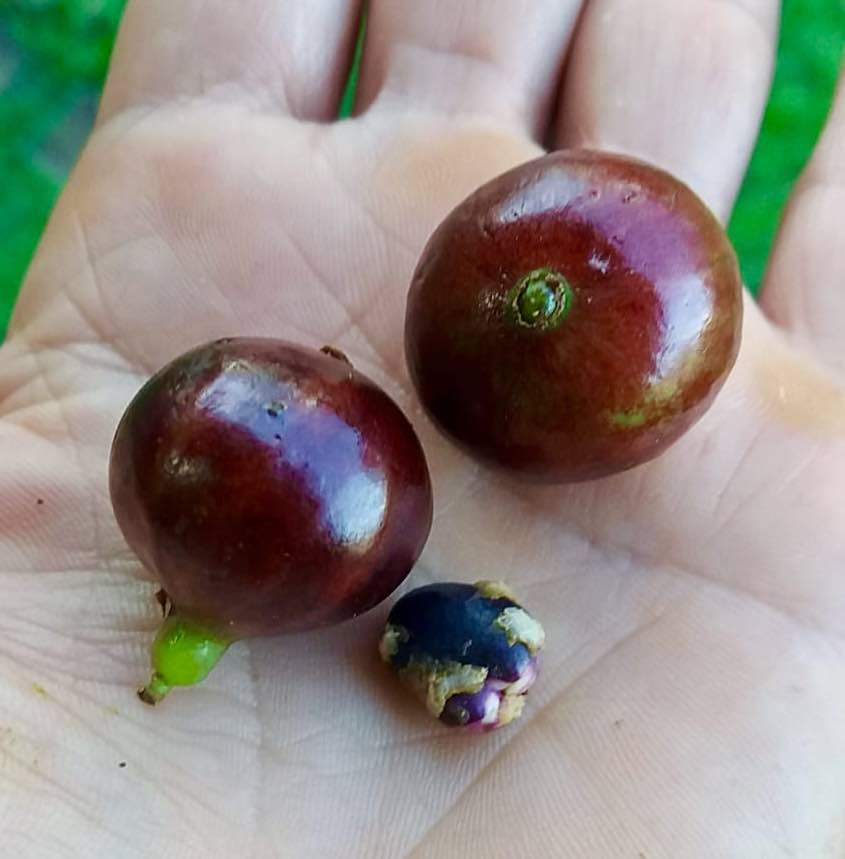
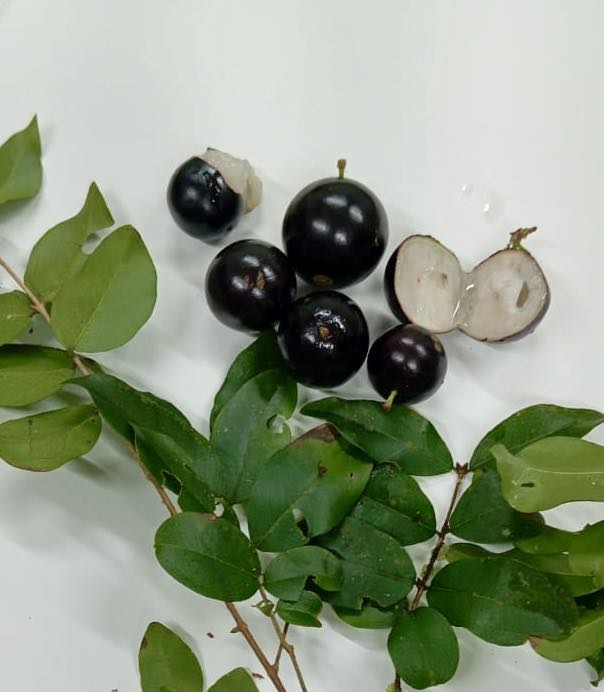
Delivery EU onlyThis Jaboticaba comes from Itabuna in Bahia Brazil.It looks like a mixture of Plinia oblongata and cauliflora.The fruits have white, very sweet and aromatic flesh.The skin is very thin and can be eaten.The seeds are germinated.In terms of taste, this Jabo gets 10 out of 10 points.Please overwinter this Jaboticaba at a minimum of 10 degrees.Diese Jaboticaba stammt aus Itabuna in Bahia Brasilien.Sie sieht aus wie eine Mischung aus Plinia oblongata und cauliflora.Die Früchte haben ein weißes, sehr süßes und aromatisches Fruchtfleisch.Die Schale ist sehr dünn und kann mitgegessen werden. Die Samen sind bereits gekeimt. Geschmacklich bekommt diese Jabo 10 von 10 Punkten.Bitte diese Jaboticaba bei mindestens 10 Grad überwintern.
Plinia sp Pingo de Mel (Vilela A3)
Family / Familie: Myrtaceaeorigin from / Herkunft: Brasil / Brasilien Climate / Klima: temperate to warm (15-30C / 59-86F) / gemäßigt bis warm (15-30C / 59-86F)Use / Verwendung: edible fruits, juice, jam, ice cream, etc. / essbare Früchte, Säfte, Marmelade, Eis usw.you buy / sie kaufen: 1 potted seedling / 1 getopfter Sämling
Delivery EU only
Plinia sp. 'Pingo de Mel' – Honey Drop Jaboticaba
– Rare Variety with Exceptionally Sweet Fruits –
Plinia sp. 'Pingo de Mel', which means “Honey Drop” in Portuguese, is one of the sweetest and most sought-after Jaboticaba varieties. A true gem for collectors and lovers of exotic tropical fruits.
Fruit & Flavor:
Small, amber to honey-colored fruits
Incredibly sweet, with an intense, almost honey-like taste
Best enjoyed fresh off the tree, but also great for juices and desserts
A unique tropical flavor experience
Growth & Care:
Compact, slow-growing tree with ornamental appeal
Perfectly suited for container cultivation
Thrives in well-draining soil and prefers a bright, sheltered location
Climate & Cultivation:
Easy to grow and low-maintenance
Tolerates short cool periods, but not frost-hardy
Must be overwintered at a minimum of 10 °C (50 °F)
Reduce watering in winter; avoid waterlogging
Note to Buyers:This rare Jaboticaba is one of the sweetest varieties in the world – a true delicacy and a highlight for any tropical fruit collection. Once you taste it, you'll always want more!
Plinia sp. 'Pingo de Mel' – Honigtropfen-Jaboticaba
– Seltene Rarität mit unvergleichlich süßen Früchten –
Plinia sp. 'Pingo de Mel', was auf Portugiesisch „Honigtropfen“ bedeutet, ist eine besonders süße und seltene Jaboticaba-Art, die vor allem bei Sammlern und Liebhabern exotischer Früchte sehr begehrt ist.
Früchte & Geschmack:
Kleine, bernstein- bis honigfarbene Früchte
Extrem süß, mit einer intensiven, fast honigartigen Note
Frisch vom Baum ein echter Genuss
Ideal für den Frischverzehr, aber auch für Säfte und Desserts geeignet
Wuchs & Pflege:
Kompakter, langsam wachsender Baum mit hoher Zierwirkung
Eignet sich hervorragend für die Kübelhaltung
Liebt durchlässige Erde und einen hellen, geschützten Standort
Kultur & Klima:
Anspruchslos und robust
Verträgt kurze kühlere Perioden, aber nicht frosthart
Überwinterung bei mindestens 10 °C
Im Winter weniger gießen und Staunässe vermeiden
Hinweis für Käufer:Diese außergewöhnliche Jaboticaba ist eine der süßesten Sorten weltweit – eine echte Delikatesse und ein Highlight für jede Sammlung tropischer Obstgehölze. Wer sie einmal probiert hat, wird sie immer wieder genießen wollen!
Plinia sp. Rajada Matriz 1
Family / Familie: Myrtaceaeorigin from / Herkunft: Brasil / BrasilienClimate / Klima: temperate to warm (10-30C / 50-86F) / gemäßigt bis warm (10-30C / 50-86F)Use / Verwendung: edible fruits, juice, jam, ice cream, etc. / essbare Früchte, Säfte, Marmelade, Eis usw.you buy / sie kaufen: 1 germinated seed / 1 gekeimter Samen
Delivery worldwideThis jaboticaba originates from the Mata Atlantica in Bahia, Brazil.The fruits are dark red to pale, with slight stripes and an elongated stem.The flesh is soft and very juicy.The flavor is delicious and typical of jaboticaba.The plant prefers a sunny to partially shaded location.In the first year after planting, a partially shaded spot is ideal to protect the delicate, young leaves.The soil should be slightly acidic and well-drained to prevent waterlogging.The plant requires regular watering but does not tolerate soggy soil.The root ball should be kept consistently moist.Ideally, it should be overwintered at a minimum temperature of 10°C (50°F).Diese Jaboticaba stammt aus dem Mata Atlantica in Bahia Brasilien.Die Früchte sind dunkelrot bis scheaz, haben eine leichte Streifung und einen verlängerten Stiel.Das Fruchtfleisch ist weich und sehr saftig. Der Geschmack ist sehr lecker und schmeckt typisch nach Jaboticaba.Die Pflanze bevorzugt einen sonnigen bis halbschattigen Standort. Im ersten Jahr nach dem Einpflanzen ist ein halbschattiger Platz optimal, um die empfindlichen, jungen Blätter zu schützen.Der Boden sollte leicht sauer sein und eine gute Drainage aufweisen, um Staunässe unbedingt zu vermeiden. Die Pflanze benötigt regelmäßige Bewässerung, verträgt aber keine nassen Füße. Der Wurzelballen sollte gleichmäßig feucht gehalten werden.Sie sollte idealerweise bei einer Mindesttemperatur von 10°C überwintert werden.
Plinia sp Sedutora
Family / Familie: Myrtaceaeorigin from / Herkunft: Brasil / Brasilien Climate / Klima: temperate to warm (15-30C / 59-86F) / gemäßigt bis warm (15-30C / 59-86F)Use / Verwendung: edible fruits, juice, jam, ice cream, etc. / essbare Früchte, Säfte, Marmelade, Eis usw.you buy / sie kaufen: 1 germinated seed / 1 gekeimter Samen
Delivery worldwidePlinia sp. Sedutora – Ultra-Rare Jaboticaba from Brazil
Description:Here you can get a very fresh seed of this ultra-rare Plinia. The tree was discovered in Ilheus (Bahia) and grows to about 3 meters in height. The fruits of this Jaboticaba are sweet. The leaves resemble those of Plinia longiacuminata, but the fruits are noticeably different.
Special Features:
Fruits: Sweet fruits
Growth: The tree reaches a height of about 3 meters, making it an interesting addition for collectors.
Rarity: A very rare Plinia
Care Instructions:
Overwinter at a minimum of 15°C (59°F).
A bright, warm location ensures optimal growth.Plinia sp. Sedutora – Ultra seltene Jaboticaba aus Brasilien
Beschreibung:Hier bekommt ihr einen ganz frischen Samen dieser ultra seltenen Plinia. Der Baum wurde in Ilheus (Bahia) entdeckt und erreicht eine Größe von etwa 3 Metern. Die Früchte dieser Jaboticaba sind süß im Geschmack. Die Blätter ähneln denen der Plinia longiacuminata, jedoch unterscheiden sich die Früchte deutlich.
Besonderheiten:
Früchte: Süße Früchte
Wuchs: Der Baum erreicht eine Höhe von etwa 3 Metern und ist eine interessante Bereicherung für Sammler.
Seltenheit: Eine sehr seltene Art der Plinia
Pflegehinweis:
Überwinterung bei mindestens 15 °C erforderlich.
Ein heller, warmer Standort sorgt für gutes Wachstum.
Plinia sp. fruta verde - folha miúda
Family / Familie: Myrtaceaeorigin from / Herkunft: Brasil / BrasilienClimate / Klima: temperate to warm (10-30C / 50-86F) / gemäßigt bis warm (10-30C / 50-86F)Use / Verwendung: edible fruits, juice, jam, ice cream, etc. / essbare Früchte, Säfte, Marmelade, Eis usw.you buy / sie kaufen: 1 potted seedling / 1 getopfter Sämling
Delivery EU onlyThis discovery from the Mata Atlantica in Bahia is a sensation for us.You only notice this sensation upon closer inspection of the photos.Many collectors are familiar with the black-fruited jaboticabas, and more experienced collectors also know the yellow- and red-fruited varieties, as well as the so-called "White Jaboticabas" (P. aureana), which, however, have a green skin.All previously known "White Jaboticabas" have large, ribbed leaves. Approximately 3 to 4 times larger than normal Plinia cauliflora (Sabara) leaves.And now look at the photos again!Yes - that's right. This "White Jaboticaba" has small leaves - only slightly larger than those of a Jaboticaba Sabara.Is this a completely new Plinia? Yes - and with a high degree of certainty.But now to the tree and the taste.The flesh is soft and very juicy. The flavor is delicious and reminiscent of a blend of Jaboticaba Sabara with a subtle hint of honey.The tree is medium-sized and, like other Jaboticabas, thrives in containers.The plant prefers a sunny to partially shaded location.In the first year after planting, a partially shaded spot is ideal to protect the delicate, young leaves.The soil should be slightly acidic and well-drained to prevent waterlogging.The plant requires regular watering but does not tolerate soggy soil.The root ball should be kept consistently moist.As a subtropical plant, 'Plinia coronata' is not frost-hardy.Ideally, it should be overwintered at a minimum temperature of 10°C (50°F).Diese Entdeckung aus dem Mata Atlantica in Bahia ist für uns eine Sensation.Auf den Fotos erkennt man diese Sensation erst auf den zweiten Blick.Viele Sammler kennen die schwarzfrüchtigen Jaboticabas und die erfahreneren Sammler kennen noch die gelb- und rotfruchtenden Arten sowie die sogenannten "Weißen Jaboticabas" (P. aureana), die jedoch eine grüne Schale haben.Alle bisher bekannten "Weißen Jaboticabas" haben große, gerippte Blätter. Ungefähr 3 bis 4 mal größer als normale Plinia cauliflora (Sabara) Blätter.Und jetzt schaut euch die Fotos noch einmal an!Ja - richtig. Diese "Weiße Jaboticaba" hat kleine Blätter - nur etwas größer als die einer Jaboticaba Sabara.Handelt es sich hier um eine völlig neue Plinia? Ja - und das mit großer Gewissheit.Doch jetzt zu dem Baum und dem Geschmack.Das Fruchtfleisch ist weich und sehr saftig. Der Geschmack ist sehr lecker und erinnert an eine Mischung aus Jaboticaba Sabara mit einer leichten Note von Honig.Der Baum ist mittelgroß und lässt sich wie die anderen Jaboticabas auch gut im Kübel ziehen.Die Pflanze bevorzugt einen sonnigen bis halbschattigen Standort. Im ersten Jahr nach dem Einpflanzen ist ein halbschattiger Platz optimal, um die empfindlichen, jungen Blätter zu schützen.Der Boden sollte leicht sauer sein und eine gute Drainage aufweisen, um Staunässe unbedingt zu vermeiden. Die Pflanze benötigt regelmäßige Bewässerung, verträgt aber keine nassen Füße. Der Wurzelballen sollte gleichmäßig feucht gehalten werden.Als subtropische Pflanze ist die 'Plinia coronata' nicht winterhart. Sie sollte idealerweise bei einer Mindesttemperatur von 10°C überwintert werden.
Plinia sp. de Talo
Family / Familie: Myrtaceaeorigin from / Herkunft: Brasil / BrasilienClimate / Klima: temperate to warm (10-30C / 50-86F) / gemäßigt bis warm (10-30C / 50-86F)Use / Verwendung: edible fruits, juice, jam, ice cream, etc. / essbare Früchte, Säfte, Marmelade, Eis usw.you buy / sie kaufen: 1 germinated seed / 1 gekeimter Samen
Delivery worldwideThis jaboticaba originates from the Mata Atlantica in Bahia, Brazil.The fruits are black, and the flesh is soft and very juicy.The flavor is delicious and typical of jaboticaba.The leaves of this jaboticaba are larger than those of a P. cauliflora.The plant prefers a sunny to partially shaded location.In the first year after planting, a partially shaded spot is ideal to protect the delicate, young leaves.The soil should be slightly acidic and well-drained to prevent waterlogging.The plant requires regular watering but does not tolerate soggy soil.The root ball should be kept consistently moist.Ideally, it should be overwintered at a minimum temperature of 10°C (50°F).Diese Jaboticaba stammt aus dem Mata Atlantica in Bahia Brasilien.Die Früchte sind schwarz und das Fruchtfleisch ist weich und sehr saftig. Der Geschmack ist sehr lecker und schmeckt typisch nach Jaboticaba.Die Blätter dieser Jaboticaba sind größer als bei einer P. cauliflora.Die Pflanze bevorzugt einen sonnigen bis halbschattigen Standort. Im ersten Jahr nach dem Einpflanzen ist ein halbschattiger Platz optimal, um die empfindlichen, jungen Blätter zu schützen.Der Boden sollte leicht sauer sein und eine gute Drainage aufweisen, um Staunässe unbedingt zu vermeiden. Die Pflanze benötigt regelmäßige Bewässerung, verträgt aber keine nassen Füße. Der Wurzelballen sollte gleichmäßig feucht gehalten werden.Sie sollte idealerweise bei einer Mindesttemperatur von 10°C überwintert werden.
Plinia sp. do Frade
Family / Familie: Myrtaceaeorigin from / Herkunft: Brasil / BrasilienClimate / Klima: temperate to warm (10-30C / 50-86F) / gemäßigt bis warm (10-30C / 50-86F)Use / Verwendung: edible fruits, juice, jam, ice cream, etc. / essbare Früchte, Säfte, Marmelade, Eis usw.you buy / sie kaufen: 1 germinated seed / 1 gekeimter Samen
Delivery worldwideThis jaboticaba originates from the Mata Atlantica in Bahia, Brazil.The tree is relatively large, but can still be grown successfully in a container.The fruits are dark red to black, and the flesh is soft and very juicy.The flavor is delicious and typical of jaboticaba.The leaves of this jaboticaba are larger than those of a P. cauliflora and are somewhat reminiscent of a Plinia coronata.The plant prefers a sunny to partially shaded location.In the first year after planting, a partially shaded spot is ideal to protect the delicate, young leaves.The soil should be slightly acidic and well-drained to prevent waterlogging.The plant requires regular watering but does not tolerate soggy soil.The root ball should be kept consistently moist.As a subtropical plant, 'Plinia coronata' is not frost-hardy.Ideally, it should be overwintered at a minimum temperature of 10°C.Diese Jaboticaba stammt aus dem Mata Atlantica in Bahia Brasilien.Der Baum ist relativ groß, lässt sich aber dennoch gut im Kübel halten.Die Früchte sind dunkelrot bis schwarz und das Fruchtfleisch ist weich und sehr saftig. Der Geschmack ist sehr lecker und schmeckt typisch nach Jaboticaba.Die Blätter dieser Jaboticaba sind größer als bei einer P. cauliflora und erinnern etwas an eine Plinia coronata.Die Pflanze bevorzugt einen sonnigen bis halbschattigen Standort. Im ersten Jahr nach dem Einpflanzen ist ein halbschattiger Platz optimal, um die empfindlichen, jungen Blätter zu schützen.Der Boden sollte leicht sauer sein und eine gute Drainage aufweisen, um Staunässe unbedingt zu vermeiden. Die Pflanze benötigt regelmäßige Bewässerung, verträgt aber keine nassen Füße. Der Wurzelballen sollte gleichmäßig feucht gehalten werden.Als subtropische Pflanze ist die 'Plinia coronata' nicht winterhart. Sie sollte idealerweise bei einer Mindesttemperatur von 10°C überwintert werden.
Plinia sp Canelinha Polpa rosea
Family / Familie: Myrtaceaeorigin from / Herkunft: Brasil / BrasilienClimate / Klima: temperate to warm (10-25C / 50-77F) / gemäßigt bis warm (10-25C / 50-77F)Taste / Geschmack: very good taste / sehr guter Geschmackyou buy / sie kaufen: 1 small potted seedling / 1 kleiner, getopfter Sämling
Delivery EU onlyThis Plinia was discovered just last year in the state of Goiás.At first glance, this Jaboticaba is somewhat reminiscent of the Plinia sp Caipirinha.However, there are some differences, so one has to assume a separate, previously unknown Jaboticaba.The fruits are dark black with shiny skin and pink, sweet and juicy flesh.Please overwinter at at least 10 degrees.Diese Plinia wurde erst im letzten Jahr im Bundesstaat Goiás entdeckt.Auf den ersten Blick erinnert diese Jaboticaba etwas an die Plinia sp Caipirinha. Es gibt allerdings einige Unterschiede, so dass man von einer eigenen, bisher unbekannten Jaboticaba ausgehen muss.Die Früchte sind dunkelschwarz mit glänzender Schale und rosafarbenen, süßen und saftigen Fruchtfleisch.Bitte bei mindestens 10 Grad überwintern.
Plinia rara var. WHITE
Family / Familie: Myrtaceaeorigin from / Herkunft: Brasilien Climate / Klima: temperate to warm (10-30C / 50-84F) / gemäßigt bis warm (10-30C / 50-84F)Use / Verwendung: edible fruits, juice, jam, ice cream, etc. / essbare Früchte, Säfte, Marmelade, Eis usw.you buy / sie kaufen: 1 germinated seed / 1 gekeimter Samen
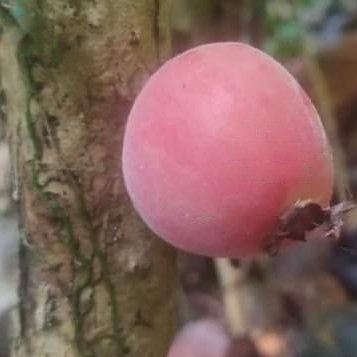
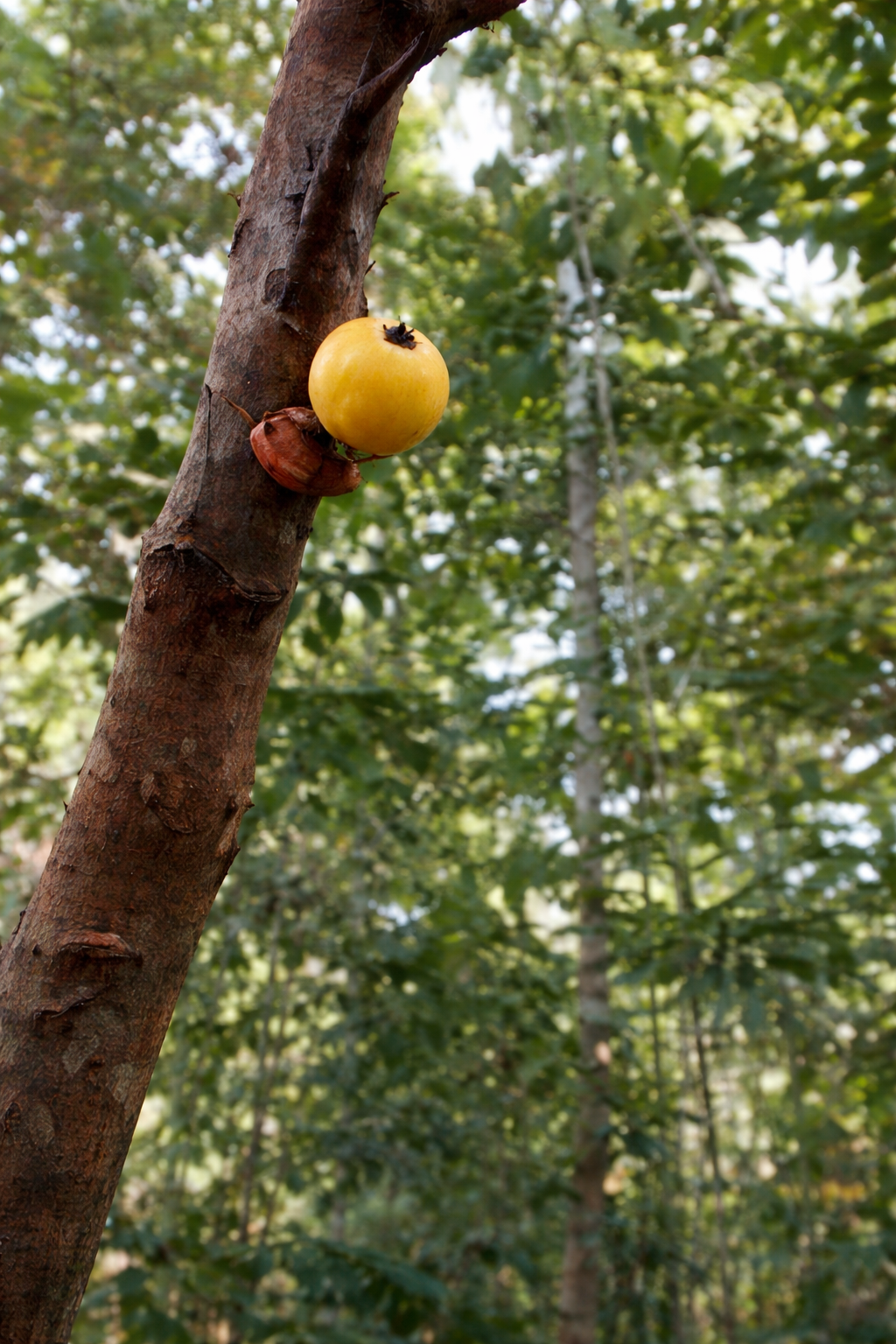
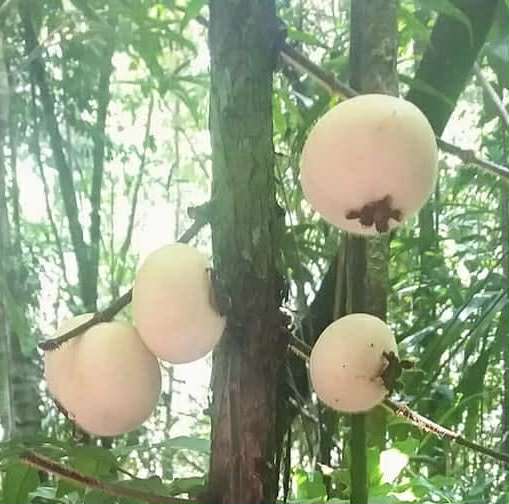
Delivery worldwideThe Plinia rara var. WHITE is one of the rarest Jaboticabas in the world.This species produces white fruits when ripe.Collectors worldwide are desperately searching for this Plinia.Plinia rara is available with green and white fruits.This is the white-fruited variety.The fruits are described as having a sweet apple flavor.This tree grows to approximately 6 meters tall, with unique, large leaves.The fruits grow cauliflower on the trunk and are approximately 7 cm in diameter.Please overwinter this plant at a minimum temperature of 10 degrees Celsius.Die Plinia rara var. WHITE gehört zu den seltensten Jaboticabas dieser Erde.Diese Art bekommt weiße Früchte wenn sie reif sind.Alle Sammler weltweit suchen händeringend nach dieser Plinia.Es gibt die Plinia rara mit grünen und mit weißen Früchten.Dieses hier ist die weißfruchtige Art.Der Geschmack der Früchte wird wie Apfelbonbon beschrieben.Dieser Baum wird ca. 6m groß, mit einzigartigen, großen Blättern. Die Früchte wachsen kauliflor am Stamm und sind ca. 7cm im Durchmesser.Bitte diese Pflanze bei mindestens 10 Grad überwintern.